The Online Voice of the Bicycle Alliance of Washington


Showing posts with label Guest Blogger. Show all posts

Tuesday, June 26, 2012

Missing the Bike Commute

Kristi races for the finish line.
Today's post was written by Bicycle Alliance member and volunteer Kristi Moen of Burien. 

I have a confession to make to all of you who are asking me if I’ve been cycling to work lately. I haven’t. 

It’s not what you think. It’s not the rain or the colder-than-average weather. Those aren’t stopping me. Nor is it the traffic or the very occasional rude driver. Nope. It’s me. I’m stopping myself. It’s odd, especially to me because much of my identity is wrapped into cycling. I’ve not been riding to work because – here’s where it gets weird – I’ve been training for triathlons. Sound strange? It does to me, too. But the more I look into training for tris, the more I find that there’s not a lot of value in my downhill, uphill, slow sidewalk, meandering route to work. (Not to mention that I paid someone a lot of money for a tri training plan and it doesn’t have room for commuting.) Sure, there’s always something to gain, but compared to an intense interval workout on my trainer or a long non-stop ride on one of our many regional bike routes, I don’t get the same time/value ratio. And for me, who can get surprisingly competitive with myself, the idea of not taking full advantage of a tri workout kills me. 


It also kills me to not ride to work. Therein lies the dilemma. But my last logic-based motivator, minimizing impact to the environment, is gone with the acquisition of my electric car. And so for now, I drive to work and continue with my very strategic tri workouts.

This is a rambling way of saying that I can’t wait until I can start commuting on my bike again. I see you all out there in the downpours and cold and can barely stand it I’m so envious. So keep it up. Keep riding. Ride more! Enlist your friends. The more of you we drivers see, the more awareness of the need for better safety and infrastructure will come to light. That’s the most important part. More safety equals more riders. And by all means, if you have ideas of how to train while commuting, please let me know.

Thursday, May 17, 2012

Tips for Newbie Women Bike Commuters


This guest blog post was written by Wendy Wheeler of Seattle.  She is a new bike commuter and a captain of a Bike to Work team for federal agency employees.

As a new commuter-cyclist, I want to share some tips that can make your ride more enjoyable, and thus more likely.
Wendy Wheeler bikes with style.

If you’re like me, you have a list of “shoulds” as long as your arm. The trick for me was to take the idea of commuting by bike and make it as fun as possible. Now, it’s something that I really enjoy and I look forward to doing, rather than something that I’m trying to squeeze into my day.

Make it easier: Metro is your friend.

The bike racks on the Metro buses are really easy to use, once you’ve done it once. Try it first on a weekend for less pressure, just load it on at one stop and take it off a couple of stops later. With the bus, you have an infinite number of ways you can slice your commute. Any part that you don’t want to ride on a particular day, you don’t have to.

Keep it easier: Have a back-up plan for rain.

My back up plan is four-fold – I could leave my bike locked in my office’s parking garage, I could stop at any point and use Metro, my top layers are water-resistant, and almost all of my clothes are machine washable anyway. So I can choose how wet I’m willing to be. When I’m warm, it doesn’t bother me. Most days in Seattle this time of year, it’s not actually raining all day, just showers that may not coincide with the ride anyway.

Make it fun: Dress it up.

I am a big fan of visibility. I have a front light and a back light on the bike and smaller ones on helmet and my backpack. I also think having a bright-colored top layer is a good idea. But I don’t feel the need to look like I’m preparing to bike the tour de France. Spandex is not my friend these days. J So I turn the “what to wear” formula on its head and go for something nicer than my normal dark work pants.

If I’m striving to be visible, why not wear a bright top and cute skirt? Skirts are among the most comfortable riding wear there is – they move with you, they tend to be lightweight, they’re already up out of the chain area, and they don’t bunch and compress in the middle. You can get tons of inexpensive skirts to try for shape/size/flow at your neighborhood Goodwill or Value Village – get something with a pattern and then even if you get drizzled-on on the way to work it will still look great. The one in my photo was originally too long, so I chopped the ruffle and some length off the bottom, reattached it, and now it’s ready to go. For spring/fall, I wear the skirt with tights. When it’s warm (here’s hoping!), I’ll wear a pair of snug yoga shorts, or boy short style underpinnings underneath, and it’ll comfortable and modest enough for unexpected cross-winds.

Likewise, on shoes, try using that pair of work shoes that are good for walking. My faves are a pair of Naots – cork insoles, adjustable strap, low heel and a bow. They have enough support to be comfortable on the pedals, but are office perfect the minute I step off the bike.

Keep it fun, don’t worry much about your hair.

I have the gift of slightly curly hair. So my office mates know that it will never look tidy anyway. This gives me freedom with how it looks post- helmet. There are websites with tips on hair and cycling, check them out if you’re going for a specific look. My tip would be to try both the wet and dry options (as long as it’s not freezing out). You may find that starting with slightly damp hair actually gives you a more controlled look after your ride (less frizz/fuzz).

Above all, enjoy your ride.

I think you’ll find that you feel better after the fresh air and workout. Enjoy that you’ve made this time to treat yourself.

The Bicycle Alliance's Go By Bike brochure also offers some good tips for getting started with biking for errands and commuting.

Monday, April 23, 2012

Off the Freeway


Today's guest blog post was written by former Bicycle Alliance staffer Mark Canizaro of Seattle.  This was originally published in July 2005 on his personal blog.

I work at a bicycle advocacy organization. Among my tasks is answering telephone and email questions about bicycling in general and frequently those are about possible routes.

Today I got a request from a father in Bellingham who had a wonderful idea as a parent. His son graduated from high school last month and is heading off to college next month. As a way of symbolizing the rite of passage, and a (possibly last) chance to spend some time together, they decided to bicycle together to Washington State University in Pullman. I thought it was a great idea. (He seemed to need my encouragement.)

Neither are serious bicyclists, but they've been enjoying riding together the last year or so and decided to take on this very big undertaking (It's 400 miles or more). His reason for calling was a routing question. He said,

"I know we go down Interstate 5 100 miles to Seattle, get on Interstate 90 and go east a couple hundred miles, but I don't know where to go once I get out towards Spokane. Can you tell me what turn to take?”

There was a long, long pause as I gathered my thoughts and prepared for a nasty conflict.

The route he was suggesting, 5 to 8 days of really miserable riding on Interstate freeways, was awful. This is not that unusual. Many people forget to stop thinking like a car when they get on a bike. Still, I was shocked... and nervous. I had a good suggestion for that last day of riding, (there is also a major highway similar to his suggestions) but I also had a half-dozen much better routes to suggest for the first week.

I took a deep breath and started in... Stevens Pass, North Cascades Highway, White Pass, Chuckanut Drive, The Skagit Valley, The Centennial Trail, back roads, country roads, bike trails, away from the highways. Quiet roads.

I finished my monologue and prepared for the response. People get very defensive about routes and it's a strangely common reaction to be pretty angry at the suggestion of quieter routes.

I was met with silence. A long silence. A concerning silence. I wasn't even sure he was still there.

Finally he said,

"I'm really embarrassed, I've lived here my whole life and it never occurred to me that there was any other way to get to Seattle except on I-5... of course it would be nicer to ride on some of those other roads."

And why don't more people bike?

I've had the same experience in Seattle with new or prospective cyclists asking me about routes around town, assuming that the ONLY option was the nasty, clogged, smelly, loud, intense, motor filled arterial. Forgetting that the quiet streets, the neighborhoods, the pleasant and interesting streets even exist. Missing the point.

Cyclists need to stop thinking like cars. Actually I think everyone: city planners, drivers, developers, pedestrians, EVERYONE needs to stop thinking like cars, but it's amazing how often I see cyclists stuck in that car-think.

Wednesday, March 21, 2012

The Ultimate Cycling Food

Today’s guest blog post was submitted by former Bicycle Alliance staffer Mark Canizaro, who lives carfree in Seattle.  This post was originally published in 2009 on Mark’s personal blog.

I was riding with a great bunch of tree-huggers on Boxing Day.

Mark with the famous Vashon Island bike tree.
Most of the time I'm middle of the pack, but this bunch was fast, I was the second slowest; and midway through our 64 hilly miles the slowest guy got dropped. It was fast, but it was fun. Right after we dropped the guy from Kansas (Vashon Island is not flat!), we came to the highway and turned left. Jon, who had never been on Vashon before asked which way the food was. He sighed when Kent said that it was the other way. I needed food too, but I didn't say anything. I usually eat almonds or granola bars on the bike, unfortunately today my pockets were empty.

It took a little extra effort, but I stayed with the group on the loop south and back around north on the beautiful rural West Side Highway. When we turned back north, Brad turned off to catch the ferry from the south point of the island. I was having a really great time but eventually it happened: I bonked. And it was a serious dropping-off-the-cliff bonk; one minute I was powering up the hill with these randonneurs and 4 minutes later I could barely the turn the cranks a flat half mile to the highway.

They waited for me. On the last hill up into town Mark rode up next to me, put his hand on the small of my back and just pushed me up the hill. I really don't know how I would've made it otherwise. I was extremely thankful, but I could only grunt one word: "Milkshake".

At the top of the hill Jon and Kent were standing there pointing to a sign on a quaint little local burger bar. The sign said: "Come in and eat or we'll both starve!" Even forgetting the economy for a moment I found that to be very deep. It was advice that none of us could resist.

In addition to a garden burger and fries, I got my milkshake. It made me happy, but more importantly, it brought me back.

Once we were at the table stuffing our faces I explained why I believe milkshakes are the ultimate cycling food.

First of all it's got fat. Fat is the oak log of energy. It burns slow and it burns long. This might not be so great if you're sitting at a desk, in a car or on the couch, but it's exactly what you want on the bike. It stays with you. For most people a milkshake will continue to fuel you for about 35 miles. For me it's about 20, but I'm weird.

Second, it's got sugar. Simple sucrose. This is the kindling, the fast burning twigs and paper of energy. It burns very quickly; you feel it almost instantly. (It goes away very fast too!) So if you're starting to drag, it gives you power to sprint down the road, if you're bonking, like I was, it restores you.

Third it's got lactose which is a complex sugar, about half the way to a carbohydrate. It's a medium burner, the dry pine log of energy, and will last longer than the sucrose.

And as the American Dairy council never misses a chance of telling us, milk has protein. Not only does that help restore overused muscles, but it helps to create the enzymes that regulate how quickly the energy, the glucose, is fed in to your bloodstream over time. It regulates your fuel flow.

Of course a milkshake also has fluids which you always need on the bike, no one ever drinks enough. And it's easy and quick to consume, I've even carried them in my bottle cage!  All of that is really important, but there are two other very important reasons why milkshakes are the ultimate bicycling food.

One, they taste good. This sounds basic, but it's actually really key. I don't know how many times I've seen folks, even some who were in the middle of a major bonk, holding on to a Power Bar, a gel, or some other gross non-food. But they weren't eating it, they were staring at it, and that doesn't fuel your body. So tasting good is great because you eat it: you actually consume it, probably quickly; and you finish it.

And lastly, you can find a milkshake almost anywhere. In the United States at least, every town, no matter how small, is going to have a restaurant, burger bar or establishment of some sort where you can get a milkshake, often a good one. Even between towns on the lonely roads there is often a possibility. This might be the most important feature. Showing up is 80%. If it's not there, it can't fuel you.

Milkshakes are great fuel, they are yummy and they show up.

The rest of the day I rode hard. I had half the milkshake at the burger bar and the other half went in my bottle cage for me to enjoy on the ferry. We rode until the shadows were long. It was a good day.

Thursday, February 2, 2012

New bike shop will help transform Pioneer Square alley into active space

This guest blog post was submitted by Ben Rainbow of Seattle.  Ben is the major domo of the soon-to-open Back Alley Bike Repair Shop.

Photo by Ben Rainbow.
When the decision was made to close Bike Port at the end of 2011, discussion ensued about the future of JRA Bike Shop’s Pioneer Square location.  Todd Vogel, local sustainable business visionary and Pioneer Square mover and shaker, was interested in having the bike shop relocate to the alley area of his historic Nord Building.  The space had been used as a non-profit conference area as well as a staging area for First Thursday Art Walk parties and receptions, and Nord Alley has hosted World Cup viewing parties, as well as a rotating array of art installations.

Hmm, let’s see… funky cool space in the heart of Pioneer Square, alley access, socially progressive landlord? Sounds pretty good. Then I come to find out that the remaining entirety of the ground floor of the Nord Building will be the new headquarters of the Bicycle Alliance of Washington and current tenants in the modern downstairs office space include Feet First, OneEnergy Renewables, and the International Sustainability Institute.

As the manager of JRA’s Pioneer Square shop, I saw this as a perfect opportunity to re-invest in Pioneer Square and have an urban commuter repair cycling emporium right off Occidental Park and the corner of First and Main. But for JRA owner Eric Berg, the massive amount of energy to move two bike shops in the same year (he had already relocated his Greenwood shop) meant change was in the air. It was with Eric’s sincerest blessings that I would buy out an inventory of tools and shop fixtures and re-open in the new alley location as Back Alley Bike Repair. Like all worthy business ventures, we sealed the deal over some delicious local pints.

I accept that creating an appealing alley destination for women (and men) is but an initial challenge that I will use to measure our success. It also might seem unlikely that people would even think to go into an alley at all. With the nature of JRA’s customers being car-free cycling commuters and the unique vision of Todd Vogel’s International Sustainability Institute to ‘activate’ the alley, I will bring my 15+ years working with bikes, urban planners, non-profits, and artists to establish what I hope will be a true gem in the Pioneer Square neighborhood.

There is a dedicated group of high-energy people called The Hub Seattle, which is developing an innovative community workspace in the former Elliot Bay Bookstore. As the vision of many passionate and invested people plays itself out, Back Alley Bike Repair will be but the first of several small businesses to transform the Nord Alley. (I laugh to myself thinking that I’ll offer the City of Seattle its first taxable transaction in Nord Alley’s history.)  This video illustrates the vision of turning the alley into active space.


To me, it’s a perfect blend of jazz, funk, and punk and a longtime dream of mine to transform the urban cycling experience. I’ve had nothing short of a blast working with Eric and his JRA Bike Shop over the past year and a half. I think it’s safe to say our customers have had some fun too. That’s not likely to change at Back Alley Bike Repair. The support I’ve received from other local businesses has been amazing. After some shop build out and dialing in the space, I hope to have things in place by Valentine’s Day. Catch the latest updates on our Facebook page.  Thanks for supporting your local bike shop and see you soon!

Wednesday, October 12, 2011

Dispatch From The SPC: Density Is Good For Our Health!

This piece was originally posted on Monday October 10, 2011 on Citytank
http://citytank.org/2011/10/10/dispatch-from-the-spc-density-is-good-for-our-health/


Dispatch From The SPC: Density Is Good For Our Health!

by Kadie Bell Sata

Editor’s note: This is the first installment of an ongoing series of dispatches from the Seattle Planning Commission.

Thornton Creek in Seattle's Northgate neighborhood

The way Seattle is planned and ultimately shaped has an immense impact on the health of the population living, working and playing within its bounds. There are numerous reports and articles that cite residents of Seattle as being healthy overall compared to others across the nation. However, our area experiences vast health inequities. The disparities in rates of chronic disease in low-income and communities of color are the result of preventable, systemic, unjust social and economic policies and practices that create barriers to opportunity.

While many feel these health problems are the result of individual behavior, the issue must be considered in a larger context. Individuals make decisions based, at least in part, on their environments. If residents live in an area where it is uncomfortable to engage in daily physical activity because they feel unsafe due to traffic speeds, noise, a lack of appropriate infrastructure or perceptions of crime, they are less likely to participate in the physical activity needed to live a healthy life.


The update of Seattle’s Comprehensive Plan and the work the city is doing in Transit Communities such as Othello, Mt. Baker, Beacon Hill, Capitol Hill, Roosevelt and West Seattle provide a primary vehicle to address barriers to opportunity. By creating healthy, sustainable and livable communities which provide housing opportunities not only for the privileged, but also for residents across the spectrum, we can ensure that everyone has an equal opportunity to choose healthy behavior for themselves and their family.

Vancouver, BC: the Dorothy Lam Children's Center, the Elsie Roy School, and the playground in David Lam Park, with Yaletown in the background; photo by Catherine Benotto
In order to accomplish this goal, the City of Seattle should increase development capacity within close proximity to high capacity transit, schools and parks, and discourage development in areas which lack the essential components of livability or are in areas that can lead to poor health outcomes, such as freeways or places that don’t have access to open space, playfields, community centers, etc. We must plan communities where people can comfortably and easily walk, bike and ride transit to their meet their daily needs, such as their job, school, park and grocery store. Ensuring these opportunities for current and future residents can help to address some preventable health problems such as asthma, diabetes, heart disease, stroke and certain types of cancer.


Planning was once closely allied to the profession of public health in addressing concerns of population well being, safety and welfare. Over the course of the last century, planning and public health have diverged into separate disciplines lacking institutional ties. Emerging threats to public health arising from community design decisions are revitalizing the ties between the two disciplines. Seattle has played a key role in use health and equity to inform planning and investments. However health indicators reveal that there is more work to do.


KADIE BELL SATA is a member of the Seattle Planning Commission. She currently works for Public Health – Seattle & King County on a federal chronic disease prevention initiative. She has experience in health policy, social and racial equity as well as environmental sustainability. Community activities includes youth mentorship, neighborhood advocacy and serving as an affiliate instructor at University of Washington’s School of Public Health.

Tuesday, October 4, 2011

Going by Bike in Tacoma

Today's guest blogger is Tacoma resident Carla Gramlich. Now that she is newly retired, she has more time for biking, photography, traveling, and guest blogging.  All photos by the author.

Since I am going to be out of town for almost a month, I decided to stay closer to town this last weekend.  There were some fun things to do in Tacoma and I was free to participate.  First up, was a Community Garden Bicycle Tour which met up at the Franklin Park Community Garden.  I noticed right away a different dynamic for this group ride--I was the oldest rider!  But that didn’t seem to matter to the rest of the riders and we went off to check out some Community Gardens.

The first garden was built on an old substation lot.  The fencing was recycled and was tall enough to keep out the deer that has been known to appear in this area.  It was a beautiful garden complete with a gazebo on a cement pad that was also a leftover from its former substation days.  A lovely sign over the gate was a welcome addition.

The second garden of the tour was the Orchard and Vine Community Garden and neighbors were having a bake sale to raise funds for the garden.  We were informed that the lot was vacant and unsightly before the transformation with raised boxes of fruits, vegetables and flowers.


We completed our tour with at the Baltimore Retirement Center.  This small garden included raised planting beds that were ADA accessible and volunteers that were excited to shows us art projects that were created by the seniors.  The ride ended up at the Proctor Farmers Market were I enjoyed lunch while listening to a jazz trio.

From the Farmer’s Market, I pedaled to the grand opening of the Tacoma Co-op.  It has taken lots of volunteer and recruiting many members to make this happen but it has finally opened.  It was interesting to hear about all the products that came from the Northwest and many that were from Tacoma.  The central location of the Co-op is a plus for bicyclists or those who prefer transit.  The City is helping with more bicycle parking and I parked at one of the newly installed bike racks.

I completed some errands, visited with some friends and had dinner at the Hub, a local bicycle hangout.  My grand total for mileage was 22 and I enjoyed riding with new and old friends on such a lovely day in Tacoma. 

Monday, October 3, 2011

The Beloved Bicycle--Elevated to Art Form for First Thursdays

This blog post was submitted Development Director JoAnn Yoshimoto.  


Inspired by our location in Pioneer Square, and the high-ceiling office space that was formerly an art gallery, the Bicycle Alliance has been hosting First Thursday Art Walks each month since June – and we plan to continue through October 6.


If you haven’t yet attended Art Walk at the Bicycle Alliance, you’re missing out on the creativity of the original bicycle-themed multi-media work. You’re missing out on the chance to have your very own “blind contour portrait” created while you wait. And you’re missing out on the opportunity to own some unique art, both decorative and functional.


Barb Culp and Andy Goulding are the proud new owners of a one-of-a-kind apple wood bench that features a vintage bicycle basket repurposed as a magazine rack. Artist Jesse Knutson is hard at work on a second bench that will hopefully be finished in time to display at the Bicycle Alliance office before it is put up for bid at our Auction on October 22.

Within five minutes of Sarah Young installing her acrylics on canvas, one of the pieces was sporting a green dot, indicating that it had been sold. “This piece just spoke to me, with its combination of Northwest native design and of course the bright red bicycle,” explained Josh Miller with a grin. “I feel a little guilty for jumping on it…should I return it and give others a chance?” Fortunately, Sarah has promised to produce more of this distinctive work, for First Thursday.

If the Bicycle Alliance ever needs a new motto, this work by Marie Zahradnik would get my vote! Marie is also the artist who creates blind contour portraits for guests at First Thursdays. I was about to include a picture of one of these portraits, but thought it better to entice you to come and see for yourself on October 6!

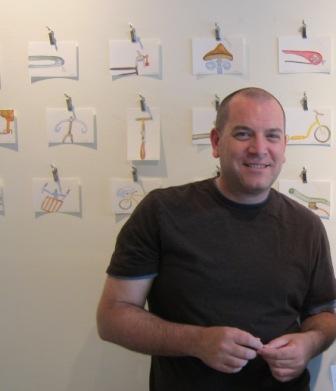
Our friend Craig Snyder works in Commuter Services at Seattle Children’s Hospital. He created especially for the Bicycle Alliance a June Drawing Cycle, a collection of drawings and paintings completed each day in June, on bicycle-related themes from daily observations. Each work is 4” x 6” graphite and acrylic on paper. Many works are already sporting telltale dots (meaning they’re sold) but some are still available for a mere $25 donation.

 When I presented this work by Lisa Reynolds to my son for his birthday, he said it was the best gift I’ve ever given him! Twenty-five years ago we used to pedal around Kilauea, Hawaii together, as captured in this encaustic piece.

Perhaps the “sketchiest” artist of all is our own Andy Goulding. He created a series of sketches of local bike shops for First Thursday, including this scene of Bike Port/JRA Bike Shop/Bicycle Alliance office.

You owe it to yourself to come on down and see the wonderful art for yourself. Our last First Thursday Art Walk of 2011 will be Thursday October 6, 5-8 pm. Hope to see you then!


Monday, August 22, 2011

Connecting the Dots in Vancouver


Today's guest blog post was submitted by Eric Giacchino of Vancouver.  Eric is the President of the recently formed Clark County Cycling Coalition. 

Cyclists in southwest Washington have something to be excited about this year as the newly formed non-profit, Clark County Cycling Coalition or “C-4” has hit our local streets and bikeways!  Using the Clark County Bicycle and Pedestrian Master Plan (approved last November) as our guide, the list of advocacy and education work C-4 has accomplished continues to grow.  And backed by a growing group of incredible volunteers from the cycling community, we’re constantly evaluating our efforts and seeking ways to improve cycling in our area.

Photo by Eric Giacchino.
In June we wrapped up our two-week bicycle safety course at two Vancouver middle schools with over 350 sixth, seventh and eighth grade cyclists.  Each student received a properly fitted helmet thanks to a generous donation from the Vancouver Bicycle Club.  Although this program has existed for almost a decade thanks to active Bicycle Alliance member Joe Gruelich, he never had the resources to expand it.  As the program gains notoriety now, C-4 was regrettably forced to decline invitations from other interested schools that also want the program...Only temporarily.

It is our vision that with enough resources we can successfully add one school a year to the program.  It took some convincing, but I helped Vancouver School District officials apply for a State Safe Routes to School grant and developed a plan to deliver the program should the District win the grant.  We’re also looking into adding after school programs and summer camps based on the availability of volunteers and finances.  The Safe Routes Grant is a necessary step for the school programs.

Last week C-4 participated in the Washington State School for the Blind tandem ride and doubled the number of tandems that rode last year.  It was a fun event and a way to reach out to a group of kids that might not otherwise have the chance to ride a bike.

 Through the summer we continue bicycle outreach and education efforts by organizing several family oriented Pedalpalooza rides last month, and staffing a bike parking facility for big events like the Ft Vancouver Fourth of July Celebration and the popular Six to Sunset Concert Series.  This continues to be an effective way to connect with the bicycle community and let people know about local trails and safe bike routes as well as our organization and programs.  We’re grateful to Vancouver Senior Planner and Bicycle Alliance Board Member Jennifer Campos for the opportunity to use the City’s bike racks and spread the bicycle word during these events.

As we grow, (115 Facebook friends and over 600 viewers a day!) we continue to search for a space that will store our school bicycle fleet and become C-4’s home.  Several bike friendly real estate agents have joined the search and pointed us toward a few positive leads.  I hope we’ll have a space soon that will evolve into a small community shop and gathering place.  The website is under construction and will host our events calendar and the usual electronic info.

I’ve noticed a marked increase in both new and veteran cyclists around town this year and its awesome!  I don’t know if it’s the cost of fuel, the desire to stay fit or simply the enjoyment of riding, but the outpouring of support only proves the area has gone far too long without a central, uniting voice for bicycling issues.  C-4 will continue to gain momentum and connect the dots of the individual efforts to become the “hub” for bicyclists and cycling issues in this area.

Keep an eye out for an invitation to our “roll out” party this Fall! 

Friday, July 8, 2011

Alert: Planned Tree Removal will Destroy the Greenway Feel of the Interurban Trail


Today's post is written by Lance Young of Shoreline.  Lance is a cyclist, concerned citizen, and the Director of the Outing Club.
 
Seattle City Light is planning to remove all the trees under the power lines along the Interurban Trail north of N 145th Street this summer rather than continue to prune them every few years to cut their costs of doing business. The natural barrier provided by the trees may become a man made barrier of wood and cyclone fences, as it has in other sections where the natural greenery has been removed.


This is what the trail corridor looks like today:


This is what it may become:


 The power company claims they will be replacing the matrue evergreens they remove with low growing bushes like this section of the trail.


It is of course important for the power company to maintain the transmission lines and electric service to the many customers they serve. According to the representatives from the the power company, one of the primary concerns of Seattle City Light is to lessen the work required to come out every few years and prune or top the trees, and it may well be less costly in the long run for them to just remove the trees entirely.  


However, this corridor is also a greenbelt with a prominent regional pedestrian and bike trail.  The interests and well being of these many users should be an important consideration in any decisions made here. Currently and over the past many decades this vegetation has been pruned and maintained to preserve the shade, the wildlife habitat, a weather barrier, and sound and visual barrier between the adjoining commercial and residential communities.  These benefits should be maintained and enhanced, not removed.

The trees along the trail provide wildlife habitat for local woodland creatures including: squirrels, chipmunks, woodpeckers, owls, and several other species of birds including flickers, finches, Steller's jays, blue herons, hawks, and many others. These trees provide shelter not only for wildlife but local residents and greenway users as well. Though the Interurban Trail is just a short distance from Aurora Avenue these many trees provide a significant sound dampening effect for the neighborhood and trail.  They also provide a significant moderating influence on wind and weather blowing through the area. Further, the removal of the trees at the street end of 149th would open up the access to this undeveloped street right of way to trail traffic which is better directed to the 148th street access.

For all of these reasons these trees should really be maintained rather than removed. In addition, removal of these mature trees will change the character of the neighborhood and the trail, and the natural barrier between the commercial properties along Aurora Ave and the residential neighborhood. The greenway view would change from mature evergreen trees to apartment units, businesses and light industrial. These many mature trees have become such an important part of the community in this area, that their removal would truly be a great loss.

The power company says they will be setting up community meetings, but that the purpose of these will be only to tell everyone what they are going to do, not to solicit suggestions or input. The plan is to remove the trees sometime this summer (August-September 2011).

What to do

If you appreciate the trees along the Interurban Trail and would like to comment on this project, below are several contacts:

Seattle Mayors Office
(The power company is accountable to the Mayor)
600 4th Ave  #7
Seattle, WA 98104
206-684-2489

Shoreline City Council
(Shoreline has the Interurban Trail right-of-way)
206-546-1303
Brian Breedon (public works, nice guy)
206-801-2441

Seattle City Light
(planning the tree cutting project)
Brent Schmidt
700 5th Ave  #3300
Seattle, WA 98104
206-386-1663


8/19/2011 Update:   The City of Shoreline has asked Seattle City Light to hold a public meeting regarding the planned removal of trees along the Interurban Trail corridor.  The meeting will be August 23 at 6:30 pm at Pacific Learning Center, 14550 Westminster Way N.