The Online Voice of the Bicycle Alliance of Washington


Showing posts with label WSDOT. Show all posts

Tuesday, July 31, 2012

Bicycle Alliance of Washington and Local Stakeholders Reach Agreement with WSDOT on Hood Canal Bridge Safety Fixes for Bicycles


FOR IMMEDIATE RELEASE: July 31, 2012                                                              

Agreement paves way to begin Hood Canal Bridge bicycle safety improvements in 2012
  
The Washington State Department of Transportation (WSDOT) will make some much needed bicycle safety improvements on Hood Canal Bridge, thanks to an agreement struck between the Bicycle Alliance of Washington, local cycling groups, and WSDOT. The agreement, funded largely from a $1.3 million federal grant, allows the state to move forward on a package of safety improvements that will widen (from 3 feet to approximately 5 feet) and improve the bridge surface for bicycles.

Since the Hood Canal Bridge’s reconstruction in 2009, narrow metal plates over the bridge decking and oft-damaged plates covering bridge joints have led to numerous crashes by those on bicycle. These concerns have prompted the Bicycle Alliance of Washington and local cycling groups to advocate for safety improvements. The proposed bridge fixes, designed by WSDOT, aim to provide a more durable, wider, and non-skid riding surface for bicycle travel.

Senator Christine Rolfes (D-Bainbridge), who played a critical role in convening discussions with WSDOT noted, “I appreciate the work of staff at WSDOT – particularly those at the Olympic Region office – who were open to thinking creatively to make this project a reality. Despite the budget constraints facing the state, WSDOT sought out new approaches to address long-standing safety issues that affect mobility, tourism, and recreation between the Kitsap and Olympic peninsulas.”

“We are elated to see the state move forward on fixes that will improve safety and accessibility across the Hood Canal Bridge,” said Bicycle Alliance of Washington executive director Barbara Culp. “The Bicycle Alliance of Washington applauds WSDOT for their diligence in pursuing this fix. We believe this agreement represents a new chapter in WSDOT’s pursuit of incorporating safety and mobility for bicycles on Washington’s bridges and we look forward to working with WSDOT to make this happen.”

The stakeholders representing bicycle clubs and organizations including Squeaky Wheels (Bainbridge), West Sound Cycling Club (Kitsap), Port Townsend Bicycle Association, and Peninsula Trails Coalition (Olympic Peninsula) have used their local knowledge and technical expertise to collaborate with the Bicycle Alliance of Washington and WSDOT Olympic Region on crafting a pragmatic solution that addresses some of the vexing safety concerns of the 2009 bridge reconstruction project.

“This is all about safety for me and the West Sound Cycling Club,” said Lee Derror, former president of the West Sound Cycling Club. “Fixing the Hood Canal Bridge for bicycle use creates a safer link between Kitsap and the rest of the Olympic Peninsula – that’s something we can all support.”

WSDOT expects the contractor selection process to occur in August 2012. Once WSDOT selects the contractor, construction is expected to take approximately five months. Drivers and bicyclists can expect shoulder closures, lane closures and one-way alternating traffic throughout the project’s duration.


###
Contact: Blake Trask
Statewide Policy Director
Bicycle Alliance of Washington
206.310.4762

Tuesday, July 24, 2012

Biking Across Snoqualmie Pass?


This post was contributed by Scott Chilberg.

Biking across the Cascades just ain’t what it used to be, thanks to I-90 construction along Keechelus Lake and a series of tunnel closures on the John Wayne Pioneer Trail between Thorp and South Cle Elum. Luckily, alternate east-west routes allow for continued bicycle access through these areas, so if you’re planning a bike trip make sure to read up on the closures prior to heading out and look out for bicycle route signs along the way. Here’s the low-down on the detours:

Due to construction of the I-90 Snoqualmie Pass East Project, WSDOT is restricting interstate bicycle access between Exit 54 and Exit 62. The suggested detour runs along the west side of the Keechelus Lake on the John Wayne Pioneer Trail. According to the WSDOT website, this 8-mile trail loops around the lake for about an hour before reconnecting with the freeway and is not recommended for racing-style bikes due to the occasional loose gravel spots and potholes. Bicyclist may also use US 12 White Pass or US 2 Stevens Pass to cross the Cascades. A map of the detour and more information regarding trail conditions and the construction project can be found
here.

Four tunnels along the John Wayne Pioneer Trail between Thorp and Cle Elum will also be closed for an indefinite period because of safety concerns. Detours for both eastbound and westbound travelers are marked along the route, so cyclists should look out for yellow signs and maps marking alternate routes. Visit the
Washington State Parks website for detailed directions and more information about the tunnel closures.

As long as you’re aware of the detours, biking along this stretch will remain very doable, so don’t be discouraged! Just make sure you’re on the alert for detour signs and, as always, do your research before embarking on your trip.

Tuesday, May 8, 2012

North Cascades Highway Ciclovia


Open streets, a.k.a. ciclovias, are events that temporarily close streets to vehicle traffic so people can use them for biking, walking, playing and socializing.  These events are gaining traction nationally and, in Washington, the cities of Seattle and Spokane organize open streets events in the summer.

Last Sunday, Steve and I participated in a ciclovia of sorts.  We biked the scenic North Cascades Highway, which is currently closed to vehicle traffic until WSDOT crews clear it of winter snow.  The highway is closed from milepost 134, east of Diablo Lake, to milepost milepost 171, 14 miles west of Mazama in the winter.
 
In the spring, bicyclists have a window of opportunity to ride portions—sometimes all—of the closed highway before the road is opened to vehicle traffic.  (And yes, it is legal to bike this highway during its closure.)  Sunny skies, combined with a WSDOT report indicating that they hoped to reopen the North Cascades Highway late this week, convinced us to bike it on Sunday.

We pulled into the Diablo Lake overlook in time to watch a group of bike riders depart for a ride up the road.  We leisurely pedaled the couple of miles to the gated closure at milepost 134.  There were more cyclists readying themselves for a ride, and a couple of pedestrians too.  In total, we encountered 25 cyclists and two pedestrians taking advantage of the car-free highway.

The ride was amazing!  Lacking a steady procession of cars and RVs, I could enjoy the sights, sounds and smells of the mountains.

We weren’t relegated to shoulder riding, but you should stay on your side of the road as you may encounter approaching cyclists, heavy equipment (except Friday-Sunday), or an occasional official vehicle.

We discovered that Bigfoot had been here!

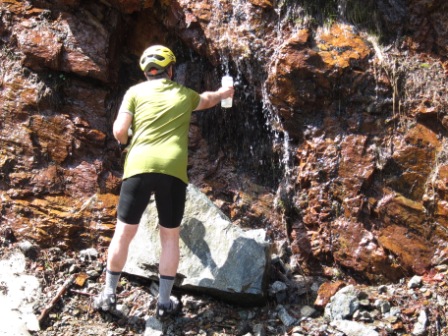
We stopped at waterfalls along the way to quench our thirst.

We witnessed where avalanches had crossed the road.

 
We reached the end of our climb and the end of the snow plowing at Rainy Pass.

We hung out with other cyclists to take a break and check out the fancy snow removal equipment before facing the long descent back to the car.

There’s also an east side version of the North Cascades Highway ciclovia via Mazama, as posted on the Methow Valley Sport Trails Association’s Facebook page.

Before you head out, be sure to get the latest report from WSDOT and check the Northwest Weather and Avalanche Center for current conditions.  The highway passes through avalanche terrain.

Tuesday, March 27, 2012

Alert: Funding Needed for Hood Canal Bridge

Calling on all recreational riders, cycling tourists, randonneuers, trail advocates and anyone who bikes on the Kitsap or Olympic Peninsulas!

Please send a letter to Secretary of Transportation Paula Hammond to request additional funding for the Hood Canal Bridge to make it SAFE for all users including bicyclists!

When the Hood Canal Bridge reopened in the summer of 2009, bicyclists from Squeaky Wheels, West Sound Cycling Club, and the Port Townsend Bicycle Association immediately identified serious safety issues with the bridge: the width and surface treatment of the plates placed over the metal grating, and gaps, joints and height variations betweeen the bridge sections.  Those same cyclists notified and met with WSDOT representatives. In the first few months that the bridge was opened, several cyclists were seriously injuried.

As executive director of the Bicycle Alliance, I started working in early 2010 with those same bicycle advocates and we successfully allied with WSDOT to acquire $1.3 million to address the safety concerns identified. WSDOT then met with those organizations to discuss design proposals and material selection with the stated goal to retrofit the bridge during the 2012 construction season.

Unfortunately, according the WSDOT project engineer, the various options under consideration will likely exceed the $1.3 million allocated for this project. Instead the cost appears more likely in the $1.8 million range. WSDOT continues to “evaluate the options with WSDOT bridge designers and the evaluation has not changed” meaning this project needs more money to create a safe riding surface for bicyclists.

Because of WSDOT’s concern over the increased cost of the project and the uncertainty over the additional funding needed, design work on the project has stopped and will not resume until such time the project engineer is advised that more funding is available to complete this project.

As process requires, a project summary was submitted to the WSDOT Program Management group that oversees funding issues, and “requested guidance on the funding piece.” ASK Secretary Hammond to please make a determination that additional funding is warranted to fix the safety issues that were identified back in the summer of 2009. 

Now is the time for WSDOT to fund the Hood Canal Bridge’s safety issues for bicycles before more cyclists are injured. Ask Secretary Hammond to:

  • Please allocate the remaining $500,000 to make the Hood Canal Bridge safe for bicycles.
  • The Hood Canal Bridge is the only connection between the Kitsap Peninsula and Olympic Peninsula and is a critical link for all types of riders.
  • The Hood Canal route attracts bicycle club riders, recreational riders, and cycling tourists from around the world. It is critical for bicycle tourism.
  • A fix will save the state money. Ongoing safety concerns about the route make the state liable for future accidents along this improperly designed bicycle connection.
  • Safety fixes now will save millions of dollars in potential liability settlements.
Send your emails to Secretary Hammond before March 30th.

Paula Hammond, Secretary of Transportation: HammonP@wsdot.wa.gov
Jerry Lenzi, Chief Engineer, lenzijc@wsdot.wa.gov
David Dye, Chief Operations Officer, DyeD@wsdot.wa.gov
Kevin Dayton – Olympic Regional Administrator, daytonk@wsdot.wa.gov
cc Jeff Cook, Olympia Region, Bridge Project Engineer, cookjd@wsdot.wa.gov
 
Please also send your emails to elected officials in the 23rd and 24th Legislative Districts:
Christine.Rolfes@leg.wa.gov
Sherry.Appleton@leg.wa.gov
Drew@drewhansen.com
Steve.Tharinger@leg.wa.gov
Jim.Hargrove@leg.wa.gov
kevin.vandewege@leg.wa.gov

Thank you again for your support and good work to make the Bridge safe for all of us.

Tailwinds

Monday, February 13, 2012

Go By Bike Program Gets Geared Up for 2012

The Go By Bike program is picking up speed and gathering momentum in 2012. We have acquired bicycles, helmets and tools for the program and are gearing up to teach bicycle safety and encourage bicycling. With grant support from WSDOT, the Bicycle Alliance is able to supply loaner bikes to participants in the Go By Bike program. The bikes are 2012 KHS Urban Xcape in both diamond and step through frame configurations. While we expect some students to have their own bikes, we did not want prospective students to be turned away for lack of a bike.


The program also supplies helmets and tools. As I wrote in an earlier post, the tools for the program were donated by Quality Bicycle Products. 

We are working with two elementary schools and four colleges to conduct safe bicycling courses in the spring, summer and fall of 2012 and spring of 2013. The elementary program engages parents of elementary students and the college program works with health and PE programs to offer a one-credit course to college students and community members.

As the Go By Bike Program Manager, I am excited and eager to get the program up to full speed. I have been working with college instructors and administrators to get the program institutionalized and to train the instructors. Participating colleges include Pierce, Olympic and Bellevue. The program for parents of elementary students is offered at Pioneer Elementary in Auburn and Suquamish Elementary in North Kitsap.

Please direct any inquiries regarding Go By Bike to joshm@bicyclealliance.org.

Tuesday, December 13, 2011

Safe Routes to School National Course Training in Yakima

Photos by the author except where noted otherwise.

Earlier this Fall I had the opportunity to participate in a Safe Routes to School National Course Training put on by the National Center for Safe Routes to School (SRTS) and co-sponsored by the Washington State Department of Transportation (WSDOT), Feet First and the Bicycle Alliance of Washington. The course was conducted October 24th-27th in Yakima, Washington and drew trainees from around the country, from northern and southern California, Michigan, Montana, Nebraska, Pennsylvania and Washington. This intensive three day training, prepared me and my co-trainees to teach the one-day SRTS National Course. The training was sponsored by the Safe Routes to School

During this training we observed the one-day course being taught in collaboration with Union Gap Elementary School, learned the curriculum, did research on local conditions, met the community, practiced teaching and then taught the course. Trainee instructors split into two groups to teach their course at two different elementary schools (Summitview Elementary and Adams Elementary). Over the three day course, the one-day course was delivered to three audiences regarding three elementary schools.

Day One: Observing the course being taught for Union Gap Elementary

The day began with a lecture and slide show, followed by a field exercise to observe existing conditions around the school. The following few photos are from our walk around the school.

Improvements to an intersection near Union Gap Elementary

Walking along the north perimeter of the school grounds

One lonely bicycle at the bike rack

Back in the office, participants in the Union Gap Elementary course look at the aerial photo and discuss potential design interventions

Participants in the Union Gap Elementary course discuss potential design interventions

The first day of the course involved observing two seasoned SRTS National Course instructors teach the course to a live audience, consisting primarily of WSDOT employees. The one-day course includes lectures, fieldwork, small group activities and a meeting with the school principal.


Day Two: Preparing to teach the Summitview class
The second day involved preparing to teach the course by practicing the course material and getting familiar with the school that the class would work with. As I mentioned earlier, the trainees split into two groups to teach the course at two different elementary schools.
Summitview Elementary School

My group worked with Summitview Elementary in the West Valley School District in Yakima, WA. In the morning we visited the school to observe student arrival and meet with the Principal of Summitview, Crystal McDonald. During our school visit we learned that there is a strong encouragement program at Summitview, working to keep students interested in active transportation.

The Golden Shoe Award at Summitview Elementary 

Looking west from the bus loading area, note recently painted crosswalk accross parking lot 

Students on their way to scool at Summitview Elementary (note student safety patrol)

In the afternoon we studied the curriculum and practiced teaching the modules of the class that we would teach the next day. 

Day Three: Teaching the Summitview class
On the third day of the training we delivered the course to an audience including folks from the school, Yakima city government, WSDOT as well as consultants and public sector employees from the Yakima area and from western Washington. We began with a series of lectures in the morning punctuated by breaks. At lunch time we had the special guests pictured below come and talk to the course participants.

Me with co-trainees and members of the student safety patrol from Summitview Elementary (Mike Cynecki Photo)

After lunch we had an interactive session on problems and solutions, two brief lectures and then we went to observe the student dismissal. After observing the dismissal time we returned to the classroom and discussed the field observations using maps and aerial photos to discuss possible design and enforcement interventions to improve safety around the school.

Aerial photo and map of the school zone facilitate discussion among participants 

Deep in thought

Conversing around the aerial photo of the school zone

Participants present back to the larger group after small group work based on the field exercise

Moving Forward
Folks that are interested in hosting the one-day Safe Routes to School National Course in their Washington community should direct their inquiries to joshm@bicyclealliance.org.  There is a fee for the course, which will vary depending on location and logistics and we will require a local coordinator to collaborate on logistics. The course is highly educational and also has the potential to galvanize a community around a Safe Rouetes to School program or campaign.


Tuesday, December 6, 2011

Some Good News on Rumble Strips


Earlier this year, we reported that the Federal Highway Administration had issued a rumble strips Technical Advisory that essentially gave no consideration to bicyclists and how rumble strips negatively impacted bicycle travel.  Read that post here.

The Alliance for Biking and Walking, Adventure Cycling Association and the League of American Bicyclists spoke up against the TA and asked FHWA to reconsider it.  Last month the FHWA issued a revised rumble strips TA and it’s a marked improvement over the original one.  It includes a section on accommodating all roadway users, with an emphasis on bicyclists.  You can read Adventure Cycling’s post about the revised TA. 

The rumble strip TA still leaves room for improvement and most of what happens is at the state and local levels.  The Bicycle Alliance worked with WSDOT to develop decent rumble strip guidelines, but the key is to make sure these guidelines are followed.  That’s where you come in!  Contact your regional WSDOT bicycle coordinator and the Bicycle Alliance if you believe there has been an incorrect installation of rumble strips in your area.

Tuesday, November 8, 2011

Some Planning Projects of Interest to Bicyclists

Bicycle friendly communities don't just happen. It takes public planning, citizen support, political will, funding and engineering.  There are opportunities in communities around the state to shape things in the planning stages to benefit bicyclists.  Here’s a sampling:

WSDOT’s SR 520 bridge replacement project is holding a Seattle community design public session on November 9.  The process is intended to further refine the basic features of this project.  The bridge replacement project includes bicycle pedestrian pathway and connections to it.  Meeting details are here.

Sound Transit’s light rail system expansion in Seattle and the Eastside (King County) have elements that impact bicyclists.  The North Link project has a couple of open houses scheduled to update the community on the Northgate Station (November 9) and Brooklyn Station (November 16).  Open house details can be found on the Sound Transit website.

The City of Federal Way is creating a Bicycle and Pedestrian master plan and held an open house on it last week.  You can still provide input.  More information can be found on the city website

Ferry County is developing a trail plan in a 28-mile railbanked corridor that stretches from Republic to the Canadian border.  Check out the Ferry County Rail Trail Partners to learn more about the planned trail.

Public comments are welcome through December 5, 2011 on the Sinclair Inlet Development Concept Plan.  The plan includes a trail connecting Bremerton and Port Orchard via Gorst.  View the plan online.

Monday, September 19, 2011

Volunteers Needed for Statewide Bicycle and Pedestrian Count

Washington State Department of Transportation will be counting bicyclists and pedestrians across the state on September 27, 28 and 29, and volunteers are needed to assist with this effort.  Counts will be assembled from all over the state, but focused on several cities including:  Bainbridge Island, Bellevue, Bellingham, Bothell, Bremerton, Burien, Ellensburg, Everett, Ferndale, Issaquah, Kelso, Kent, Kirkland, Longview, Lynden, Mercer Island, Mountlake Terrace, Oak Harbor, Olympia, Redmond, Renton, Richland Seattle, Shoreline, Spokane, Tacoma, Tukwila, Vancouver, Walla Walla, Wenatchee and Yakima.  Information about the statewide count can be found here.

WSDOT is working with the Cascade Bicycle Club to coordinate volunteers.  If you’re interested in volunteering contact:

Ian Macek
Phone: 360.705. 7596

Tessa Greegor
Phone: 206.204.0913

Thursday, September 15, 2011

Presentation on the Safe Routes to School Bike and Pedestrian Statewide Education Program in Washington

Photographs by the author.

The Bicycle Alliance of Washington, in collaboration with Feet First, the Washington State Department of Transportation (WSDOT) and the Office of Superintendent of Public Instruction (OSPI) is delivering a two year, grant-supported safe bicycling and walking education program to middle school students across the state. “It provides bicycle and pedestrian safety education to students in Grades 5-8 in approximately 25 school districts across the state.” http://www.saferouteswa.org/schools/safety-education/title-page

At the Safe Routes to School National Conference in Minneapolis Seth Schromen-Wawrin (Bicycle Alliance of Washington), Jen Cole (Feet First) and Charlotte Claybrook (the Washington State DOT Safe Routes to School Coordinator) presented on the statewide program. The presentation was on Thursday morning August 18, 2011 at the Minneapolis Convention Center. The presentation was fun and informative and the presenters did an excellent job engaging the audience.

Charlotte Claybrooke and Seth Schromen-Wawrin address the audience.


Jen Cole talks about curriculum and teacher training.

Jen Cole launching into her presentation on "Eyeballs" the interactive classroom game played with ping pong balls. http://www.saferouteswa.org/schools/safety-education/curriculum/Lesson%203%20-%20OSPI_Final_XIII_Full.pdf


More "Eyeballs."

And more "Eyeballs."


Audience members play "Captain Barclay."
The game is on!
It's getting more serious...

Participants on the edge of their seats.

The charade round of "Captain Barclay."

Playing Captain Barclay con gusto.
As you can see, Jen, Charlotte and Seth did an excellent job of making the presentation interactive and informative and engaging the audience in active learning. More information about Washington's State-wide Safe Routes to School program can be found here: http://www.k12.wa.us/HealthFitness/SafeRoutes.aspx


Tuesday, August 9, 2011

Rumbling (again) about rumble strips


Rumble strips were incorrectly applied on Whidbey Island.
Rumble strips are the bane of existence for many cyclists, and the Bicycle Alliance has wrangled with Washington State DOT over their application of this device in the past.  Here’s a link to past posts that mention rumble strips.  Well, rumble strips are rearing up again—this time at the federal level.

Bad news:  The Federal Highway Administration recently issued a technical advisory that essentially gives the green light to extensive use of rumble strips.  Read Adventure Cycling Association’s take on it here.

Good news:  Several years ago, the Bicycle Alliance worked with WSDOT to create a set of rumblestrip guidelines with bicyclists in mind.  Since the FHWA released a technical advisory, WSDOT is not required to follow it and will continue to use its own guidelines.

The Bicycle Alliance will continue to work with Adventure Cycling and our other national partners to try to improve the rumble strip situation for all cyclists.  We also need your help.  If you believe that there has been an incorrect installation of rumble strips in your area, contact the WSDOT bicycle coordinator and your regional WSDOT bicycle coordinator, and notify the Bicycle Alliance.